
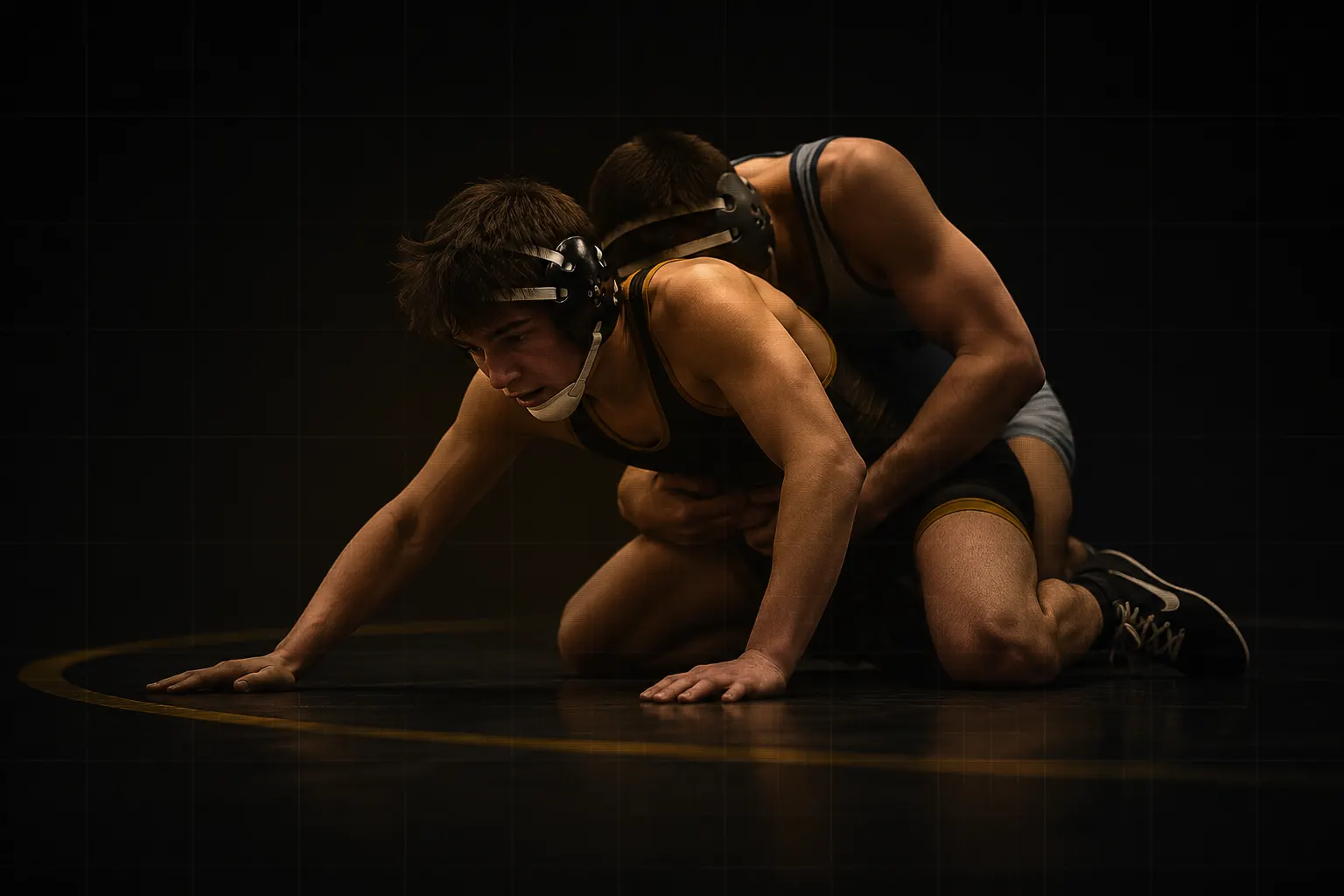
The 4-part anatomy of a scoring shot
Every successful takedown — double leg, single leg, high crotch, low single — is the same four phases in sequence: stance and motion, level change, penetration step, finish. When a shot doesn't score, the problem is almost always one of these four phases, not the whole shot.
The single most useful thing you can do for your wrestling is to learn to film yourself, identify which phase broke, and drill only that phase. This is exactly what film review with a coach is for.
Phase 1 — Stance and motion
If your stance is too high or too square, you can have a perfect penetration step and still get stuffed because your opponent saw you load up. A good stance is athletic, slightly staggered, with hips loaded — like a shortstop ready to move in any direction.
Common stance mistakes that show up on film: hands too low (gets you snapped down), hips too high (telegraphs the shot), feet parallel (slow level change), and standing flat-footed (no hand fighting threat).
- Hands active at chest/shoulder height, not by your knees
- Lead foot slightly forward — not parallel
- Knees bent enough that a coach watching can see your hips drop on motion
- Constant motion — never static long enough for your opponent to set their own stance
Phase 2 — Level change
A level change is dropping your hips before your feet move. If your head dips first, you're bending — not changing levels — and your opponent will sprawl on your head every time. Wrestlers who can't score on shots almost always have this wrong on film, and almost always think they're doing it right in practice.
Drill it slow against a wall: drop your hips straight down until your thighs are at 45 degrees, with your chest still tall. That's the position your shot starts from.
Phase 3 — Penetration step
The penetration step is one explosive step where your lead knee drives toward — and through — your opponent's hip. Not at their feet. Not at the mat in front of them. Through their hip. This is what separates a shot that scores from a shot your opponent sees coming.
If your penetration step lands short, you'll be reaching for the leg with your arms, and any decent wrestler will sprawl and front-headlock you. If it lands deep, your hips are already past their defense and the finish becomes easy.
Phase 4 — Finishing
More shots are lost in the finish than in the setup. You got to the leg — now what? Most wrestlers freeze. Good finishes are pre-decided: if I'm on the right leg with their weight forward, I run the pipe. If their weight is back, I lift and turn the corner.
Pick one finish per shot and drill it until it's reflex. Then add the second option. Trying to have five finishes ready in the moment is how you end up with none.
How to use film to actually improve
Filming your matches is non-negotiable if you want to improve faster than the wrestlers around you. But film alone doesn't help — you need someone who can tell you which of the four phases is failing.
That's the whole point of Eagle Eye Training. Upload a 60-second clip of a shot that didn't score, ask one specific question ("why did I get sprawled on?"), and a national-team coach sends back a video breakdown pointing at the exact phase that broke.
Frequently asked questions
With focused film review and drilling on one phase at a time, most wrestlers see a measurable improvement in scoring percentage within 4–8 weeks. Trying to fix everything at once usually takes much longer.
A double leg from a square stance. It teaches all four phases cleanly and is the foundation that single legs and high crotches build on.
Both. Solo drilling locks in the motion (stance, level change, penetration step). Partner drilling teaches you how to read reactions and set up the finish. You need both, every week.